PDF sha256 55acd9c1b752cca45d123e3ddfca7fab383b04449b04002f9a3683c17368d43c. Text identical to the paper of 8 November 2026 (source sha256
9db1e22f017c557b…), with this site's correspondence address added to the affiliation line.
Quantum entanglement explained: two nodes on one wave
Abstract. The theory of this paper is a short list of statements about entanglement, set out in Section 1. They say that an entangled pair is one wave with two nodes, that a node is made only when real matter meets the wave. By a node I mean a point of the wave fixed by its phase and made at a meeting, which is not the standard node of a standing wave. I set the statements beside published measurements, each with its number and source, and beside the few published theorems that go with them. Two of those facts carry the measured Bell numbers. For the entangled states used in these tests, the correlation of two distant readings follows the cosine of the angle difference, and clicks follow the wave’s intensity. If that cosine has one contrast V at all four ideal Clauser–Horne–Shimony–Holt (CHSH) settings, the CHSH parameter S equals 2√2 V. Dividing the four measured values S = 2.697 ± 0.015, 2.73 ± 0.02, 2.42 ± 0.20 and 2.37 ± 0.09 by 2√2 gives effective contrasts of 0.954, 0.965, 0.856 and 0.838, which are calculated from S and were not measured on their own. Six readings of the statements match the facts cited. No fourth direction of space is seen in the tests cited, down to 52 µm in gravity. The measured S fits the reading that the pair is one wave read once for both ends. On my reading a dark place is where two parts of the wave of equal size meet exactly out of phase. Every massive particle in the interference tests cited, from electrons to C₆₀ molecules, shows a wave, and the Bell results, which rule out values fixed in advance under locality and setting independence, fit the reading that no value is present before the meeting. The theory takes every number from standard quantum mechanics and changes how those numbers are read.
1. The theory
The theory consists of the thirteen statements below. Everything else in the paper is taken from published work, measurements and theorems alike, or is a reading of the statements, which I mark as a reading and set beside the facts.
- There is no fourth dimension. Think of entangled waves as ropes fixed at two points on the fabric of reality, and test this.
- The quantum two-valuedness of a particle is in fact two nodes on an electromagnetic wave.
- The two nodes do not define a plane. A plane is fixed by three points in space, and any two points always lie in some plane, so two points alone fix none.
- Every piece of matter in superposition is a node in the wave.
- In superposed states the wave can be zero.
- The usual account treats the interaction as a wave meeting matter. It is in fact an interaction between two states of the wave.
- I use the rope only as a simplification.
- The analyser is also a particle, an observable mass of the same wave, and it can be nothing else.
- A node is always made at the meeting. There is no hypothetical node.
- It is a wave particle. The observer’s tools interact with it, or create the quantum entanglement, and that makes the spatial points into nodes.
- Every particle that has mass is a complex wave. I do not call a cluster of mass superposed.
- Physics explains most of matter for practical purposes, but it should never be taken as absolute truth. At best it is a theory, a way to explain waveforms in the form of mass.
- The theory changes the interpretation of how things are done, and the intuition for it.
The rope is only a picture I use for teaching (statement 7), so a test on a real rope clamped at both ends tests that picture only. Statements 2, 3, 4, 9 and 10 use the word node in the sense given in the abstract. Since the analyser and the detector are matter, they are states of the same wave (statements 6, 8), and a reading is two states of one wave meeting. Two nodes fix only a line. A plane needs a third point, and the nodes themselves are made only at a reading (statement 9), so before a reading there is no plane between them (statement 3). I drop the word “electromagnetic” from statement 2 after this. Pauli wrote in 1925, in German, of “a peculiar, classically non-describable two-valuedness” [1], and I follow Pauli in calling the property statement 2 names two-valuedness. When I say a reading matches the facts, I mean that none of the measurements cited here contradicts it, which in Popper’s sense [2] leaves it open to the next test (statement 12).
Einstein, Podolsky and Rosen [3], and Schrödinger later in the same year [4], wrote down in 1935 the idea that two particles can share one state, and Bohm later gave the two-valued version [5]. What my statements add is the picture of a single wave whose nodes appear at the meeting, with no extra dimension needed for it.
2. The facts it rests on
Everything in this section was published by others, and none of it depends on my theory. Most entries are measurements, given with their number, paper and year, and where an entry also states a theorem (the Bell bound, no signalling, the geometry of wave zeros, relativistic addition of speeds) I say so.
- Fact 1. For the entangled states used in these tests, the correlation of two distant readings follows the cosine of the angle difference between the analysers, with its sign set by the state and, for photon polarisation, with the angle doubled. The CHSH parameter S [6], a signed sum of four such correlations, was measured as 2.697 ± 0.015 by Aspect and colleagues in 1982 [7]. Weihs and colleagues switched the analysers while the photons were in flight and got 2.73 ± 0.02 in 1998 [8]. With electron spins 1.3 km apart, and the detection and locality loopholes closed together, Hensen and colleagues measured 2.42 ± 0.20 in 2015 [9], and their own null-hypothesis test gave p = 0.039. Between two ground stations 1,203 km apart it was 2.37 ± 0.09 in 2017 [10]. In quoted uncertainties these lie (2.697 − 2)/0.015 = 46.5, (2.73 − 2)/0.02 = 36.5, (2.42 − 2)/0.20 = 2.1 and (2.37 − 2)/0.09 = 4.1 above 2, and these ratios are my arithmetic, which does not replace the experiments’ own statistical tests. Under locality and setting independence, 2 is the largest value any account allows in which each end reads a value fixed in advance [11, 6], and for the three photon tests the bound also assumes that the detected pairs are a fair sample of all pairs. In the 1982 test the analyser settings stayed fixed during each run, so locality was assumed there and not enforced. All four lie below 2√2 ≈ 2.828, the largest value quantum mechanics allows [12].
- Fact 2. Taken alone, each end gives each outcome about half the time whatever the other end is set to, within the statistics of the tests above. That the local rates do not depend on the far setting is a theorem of the quantum rules, no signalling [13, 14], and the equal halves follow for the maximally entangled states these tests prepare.
- Fact 3. Single particles build interference fringes one click at a time, and the click count follows the wave’s intensity. This has been seen with electrons [15, 16], and C₆₀ molecules gave a diffraction pattern counted molecule by molecule with a scanning detector [17].
- Fact 4. One photon sent to a beam splitter rarely makes both detectors click. Grangier and colleagues measured in 1986 the anticorrelation parameter α, the probability of a double click divided by the product of the two single-click probabilities, as α = 0.18 ± 0.06, where a classical field gives α ≥ 1 [18].
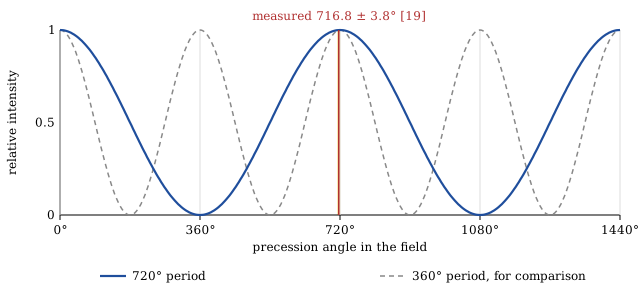
- Fact 5. A neutron wave rotated by a magnetic field in one path of an interferometer, against an unrotated wave in the other, only returns to itself after 720° of rotation. Rauch and colleagues measured the period as 716.8 ± 3.8° in 1978 [19], which sits (720 − 716.8)/3.8 = 0.84 quoted uncertainties from 720° and (716.8 − 360)/3.8 = 93.9 from 360° (Figure 1). At 360° the wave comes back with its sign flipped, as Rauch and colleagues and Werner and colleagues saw independently in 1975 [20, 21].
- Fact 6. Lee and colleagues found in 2020 that the inverse-square law of gravity fits their data at separations from 52 µm to 3.0 mm [22]. Gravitational waves from GW170817 lose strength with distance as in D = 4.02 +0.07 −0.10 spacetime dimensions, a minimal 68 % credible interval that assumes the SH0ES value of the Hubble constant, in a model where gravity may leak into extra dimensions [23]. Each of these tests can only rule out the kind of extra dimension it was designed to find, over the range of scales it actually probes.
- Fact 7. Cover one of the two slits and clicks start arriving at what used to be a dark fringe, while with both slits open that spot stays at a minimum [16]. In the interaction-free measurement of Kwiat and colleagues, where an object is detected without a photon being absorbed by it, single photons went through a Michelson interferometer set so that one output stayed dark, and an object blocking one arm sent photons to that output [24].
- Fact 8. In a smooth complex scalar wave spread over two or three dimensions, the intensity is zero at points in a plane, or along lines in space, where the phase is not defined [25]. Because of finite resolution and noise, an instrument records such a place as a minimum and cannot show that the intensity there is exactly zero.
- Fact 9. Nobody has found an ether, a medium for light filling empty space. Michelson and Morley expected a shift of 0.4 fringe from the ether model and saw less than about 0.02 in 1887 [26], and in 2009 a rotating-cavity test bounded any difference in the speed of light c between the directions it probed at about 10⁻¹⁷ in Δc/c [27].
- Fact 10. To first order in the water’s speed, light in moving water is dragged along by the fraction 1 − 1/n² of that speed, neglecting dispersion, where n is the refractive index of the water [28, 29]. Relativistic addition of speeds gives this without an ether [30].
3. Calculations on the facts
Calculation 1 (the Bell numbers from the cosine and the clicks). Each correlation E counts the joint clicks where the two ends agree, minus those where they disagree, divided by all joint clicks, and the clicks themselves follow the wave’s intensity (fact 3). Suppose, as fact 1 reports, that E follows the cosine of the angle difference with one contrast V at all four settings and no offset. At the ideal Clauser–Horne–Shimony–Holt settings three angle differences are 45° and one is 135°, in the angle each experiment uses (twice the polariser angle for photons), and with the signs of the outcomes chosen to suit the state, S = V (3 cos 45° − cos 135°) = 2√2 V. Under these assumptions the four measured values give effective contrasts V = S/(2√2) = 0.954 ± 0.005 [7], 0.965 ± 0.007 [8], 0.856 ± 0.071 [9] and 0.838 ± 0.032 [10]. They are calculated from S and are not contrasts measured on their own, and since losses, dark counts and readout errors in the real experiments differ between the ends and between settings, one V describes each experiment only on average. Calculation 1 re-expresses each measured S through the cosine and one contrast, and it does not derive the cosine from the statements of Section 1, which I take from the experiments.
Calculation 2 (where a wave can be zero). For a complex wave to vanish, its real and imaginary parts both have to be zero at the same spot, two conditions at once. For a smooth scalar wave with no special symmetry that happens at isolated points in a plane and along lines in space, and Nye and Berry showed such places are generic and stable [25]. Since a point or a line has no area or volume, a click has zero chance of landing exactly on one, as for any single point, and a detector of finite size always takes in the brighter area around it. So a zero can be there in the description while no reading can show that the intensity there is exactly zero, although its place can be found from the minimum and from the way the phase winds around it (fact 8).
Calculation 3 (the one number the rope picture gives). A body tied by strings to fixed surroundings can have its strings untangled, without moving the body, after a rotation of 720° but not after one of 360°. This is Dirac’s string problem, which Newman proved in 1942 [31], and it is also Feynman’s plate trick [32]. It comes from how rotations work in three dimensions, with no fourth direction involved. Read as such a tie, the rope of statement 1, fixed at two points, gives the same 720°, which agrees with the neutron period of 716.8 ± 3.8° (fact 5). Quantum mechanics reaches the same 720° by a different road, through the rotation rule for two-component waves, which changes their sign at 360° and restores it at 720°.
4. What matches the facts
- No fourth dimension (statement 1). No fourth direction of space shows up in the gravity test down to 52 µm, and gravitational waves spread as in four spacetime dimensions within the model and interval of fact 6, each test reaching only the kinds of extra dimension it can find. The 720° return needs only three dimensions of space (calculation 3, fact 5). By “the fabric of reality” in statement 1 I do not mean a medium carrying the wave, because the ether tests found none (fact 9). The drag of light in moving water is explained without one (fact 10), and none of the measurements cited here contradicts this reading.
- One wave for both readings (statements 1, 7). If the pair is one wave read once for both ends, with the cosine of fact 1 and one contrast for each experiment, calculation 1 expresses each measured S through that one contrast. The four measured values lie above 2 by 46.5, 36.5, 2.1 and 4.1 quoted uncertainties, and below 2√2 (fact 1), with the rope of statement 1 as the teaching picture of statement 7 for this one wave.
- A dark place is a meeting out of phase (statements 5, 6). On my reading both parts of the wave reach a dark fringe with equal size and opposite phase, so in the ideal case they add to zero and no click happens there. That fits what is seen when one part is taken away, since covering a slit or blocking an arm brings the clicks back (fact 7).
- The wave can be zero in superposed states (statement 5). Where the two parts of a complex wave cancel in both their real and imaginary parts, the wave is zero. For a wave with no special symmetry such places are generic and stable at isolated points in a plane and along lines in space (calculation 2, fact 8), and an instrument reads them as minima within its resolution.
- Every particle with mass is a wave (statement 11). Electrons build fringes one click at a time and C₆₀ molecules give a diffraction pattern counted molecule by molecule, with the clicks following the intensity (fact 3). Waves added over a spread of wave numbers, with their phases lined up, gather into a packet, and for a fixed spectral shape the packet gets narrower as the spread grows. This Fourier relation between position and wave number is how something that is a wave can still look like a particle sitting in one place, while the single click at one place follows the intensity rule of fact 3.
- Nodes made only at the meeting (statements 9, 10). The standard quantum rules for the meeting give S above 2 for the states and settings of fact 1, which values fixed in advance cannot give under locality and setting independence, and this fits the reading that nothing is settled before the meeting. The same rules also give each end on its own each outcome half the time, whatever is done at the other end (fact 2), and a single photon one click at one detector, with double clicks suppressed far below the classical level (fact 4).
5. What the theory changes
Every number in this paper is a published measurement, a value from a cited theorem, or my arithmetic on these, and every rule used to connect them is standard quantum mechanics or a cited theorem. What the statements change is the way I read them (statement 13). I read the pair as one wave, with no copy of an answer travelling inside each particle, and I take no outcome to be fixed until real matter meets that wave. Following statement 8, the analyser belongs to the same wave as the particle it measures. At an ideal dark fringe both parts of the wave arrive with equal size and opposite phase, their sum is zero, and the meeting makes no click, with no fourth direction of space needed for it. Following statement 12, I treat physics as at best a theory and never as absolute truth, so each match in Section 4 is agreement with the measurements cited here and stays open to the next one.
Data availability
Every measured value comes from the publications cited. My own experiments are simulations, run with two simulators physicists already use, MEEP for Maxwell’s equations [33] and QuTiP for the quantum readings [34]. One source driving a wave to two fixed points 14 units apart gives the same plane of the electric field at both, 30.0 degrees each, equal in the computation to one part in 10^13. A wave between two perfect mirrors shows the first six modes at n c/2L to within 5 parts in 10^4, with n + 1 zeros of the field counting both ends for the first four. For the photon pair the readings give S = 2√2, the same whichever end is read first, and each end alone gives each outcome half the time at every setting of the other end. With the plane fixed at the source instead, S = √2, and a rope model that carries one plane and answers all-or-nothing at each end gives S = 2.000. The contrast that brings the simulated S to each measured S is 0.954, 0.965, 0.856 and 0.838, the same values as the effective contrasts below. A half-integer rotation returns to its negative at 360 degrees and to itself at 720 degrees. The distances in units of the quoted uncertainty are my own arithmetic, (2.697 − 2)/0.015 = 46.5, (2.73 − 2)/0.02 = 36.5, (2.42 − 2)/0.20 = 2.1, (2.37 − 2)/0.09 = 4.1, (720 − 716.8)/3.8 = 0.84 and (716.8 − 360)/3.8 = 93.9. The effective contrasts are S/(2√2) = 0.954 ± 0.005, 0.965 ± 0.007, 0.856 ± 0.071 and 0.838 ± 0.032, with each uncertainty the quoted uncertainty of S divided by 2√2. All the discoveries that came with this research are at https://ratnamchandra.com.
Competing interests
The author declares no competing interests.
Funding
Self-funded.
References
[1] W. Pauli, Über den Zusammenhang des Abschlusses der Elektronengruppen im Atom mit der Komplexstruktur der Spektren, Z. Phys. 31, 765 (1925). doi:10.1007/BF02980631
[2] K. Popper, Logik der Forschung (Springer, Vienna, 1934).
[3] A. Einstein, B. Podolsky, and N. Rosen, Can quantum-mechanical description of physical reality be considered complete?, Phys. Rev. 47, 777 (1935). doi:10.1103/PhysRev.47.777
[4] E. Schrödinger, Discussion of probability relations between separated systems, Math. Proc. Camb. Philos. Soc. 31, 555 (1935). doi:10.1017/S0305004100013554
[5] D. Bohm, Quantum Theory (Prentice-Hall, Englewood Cliffs, 1951), ch. 22.
[6] J. F. Clauser, M. A. Horne, A. Shimony, and R. A. Holt, Proposed experiment to test local hidden-variable theories, Phys. Rev. Lett. 23, 880 (1969). doi:10.1103/PhysRevLett.23.880
[7] A. Aspect, P. Grangier, and G. Roger, Experimental realization of Einstein-Podolsky-Rosen-Bohm Gedankenexperiment: a new violation of Bell’s inequalities, Phys. Rev. Lett. 49, 91 (1982). doi:10.1103/PhysRevLett.49.91
[8] G. Weihs, T. Jennewein, C. Simon, H. Weinfurter, and A. Zeilinger, Violation of Bell’s inequality under strict Einstein locality conditions, Phys. Rev. Lett. 81, 5039 (1998). doi:10.1103/PhysRevLett.81.5039
[9] B. Hensen et al., Loophole-free Bell inequality violation using electron spins separated by 1.3 kilometres, Nature 526, 682 (2015). doi:10.1038/nature15759
[10] J. Yin et al., Satellite-based entanglement distribution over 1200 kilometers, Science 356, 1140 (2017). doi:10.1126/science.aan3211
[11] J. S. Bell, On the Einstein Podolsky Rosen paradox, Physics 1, 195 (1964). doi:10.1103/PhysicsPhysiqueFizika.1.195
[12] B. S. Cirel’son (Tsirelson), Quantum generalizations of Bell’s inequality, Lett. Math. Phys. 4, 93 (1980). doi:10.1007/BF00417500
[13] P. H. Eberhard, Bell’s theorem and the different concepts of locality, Nuovo Cimento B 46, 392 (1978). doi:10.1007/BF02728628
[14] G. C. Ghirardi, A. Rimini, and T. Weber, A general argument against superluminal transmission through the quantum mechanical measurement process, Lett. Nuovo Cimento 27, 293 (1980). doi:10.1007/BF02817189
[15] A. Tonomura, J. Endo, T. Matsuda, T. Kawasaki, and H. Ezawa, Demonstration of single-electron buildup of an interference pattern, Am. J. Phys. 57, 117 (1989). doi:10.1119/1.16104
[16] R. Bach, D. Pope, S.-H. Liou, and H. Batelaan, Controlled double-slit electron diffraction, New J. Phys. 15, 033018 (2013). doi:10.1088/1367-2630/15/3/033018
[17] M. Arndt, O. Nairz, J. Vos-Andreae, C. Keller, G. van der Zouw, and A. Zeilinger, Wave–particle duality of C60 molecules, Nature 401, 680 (1999). doi:10.1038/44348
[18] P. Grangier, G. Roger, and A. Aspect, Experimental evidence for a photon anticorrelation effect on a beam splitter: a new light on single-photon interferences, Europhys. Lett. 1, 173 (1986). doi:10.1209/0295-5075/1/4/004
[19] H. Rauch, A. Wilfing, W. Bauspiess, and U. Bonse, Precise determination of the 4π-periodicity factor of a spinor wave function, Z. Phys. B 29, 281 (1978). doi:10.1007/BF01321193
[20] H. Rauch, A. Zeilinger, G. Badurek, A. Wilfing, W. Bauspiess, and U. Bonse, Verification of coherent spinor rotation of fermions, Phys. Lett. A 54, 425 (1975). doi:10.1016/0375-9601(75)90798-7
[21] S. A. Werner, R. Colella, A. W. Overhauser, and C. F. Eagen, Observation of the phase shift of a neutron due to precession in a magnetic field, Phys. Rev. Lett. 35, 1053 (1975). doi:10.1103/PhysRevLett.35.1053
[22] J. G. Lee, E. G. Adelberger, T. S. Cook, S. M. Fleischer, and B. R. Heckel, New test of the gravitational 1/r² law at separations down to 52 µm, Phys. Rev. Lett. 124, 101101 (2020). doi:10.1103/PhysRevLett.124.101101
[23] K. Pardo, M. Fishbach, D. E. Holz, and D. N. Spergel, Limits on the number of spacetime dimensions from GW170817, J. Cosmol. Astropart. Phys. 2018 (07), 048 (2018). doi:10.1088/1475-7516/2018/07/048
[24] P. Kwiat, H. Weinfurter, T. Herzog, A. Zeilinger, and M. A. Kasevich, Interaction-free measurement, Phys. Rev. Lett. 74, 4763 (1995). doi:10.1103/PhysRevLett.74.4763
[25] J. F. Nye and M. V. Berry, Dislocations in wave trains, Proc. R. Soc. Lond. A 336, 165 (1974). doi:10.1098/rspa.1974.0012
[26] A. A. Michelson and E. W. Morley, On the relative motion of the Earth and the luminiferous ether, Am. J. Sci. 34, 333 (1887). doi:10.2475/ajs.s3-34.203.333
[27] S. Herrmann, A. Senger, K. Möhle, M. Nagel, E. V. Kovalchuk, and A. Peters, Rotating optical cavity experiment testing Lorentz invariance at the 10⁻¹⁷ level, Phys. Rev. D 80, 105011 (2009). doi:10.1103/PhysRevD.80.105011
[28] H. Fizeau, Sur les hypothèses relatives à l’éther lumineux, C. R. Acad. Sci. 33, 349 (1851).
[29] A. A. Michelson and E. W. Morley, Influence of motion of the medium on the velocity of light, Am. J. Sci. 31, 377 (1886). doi:10.2475/ajs.s3-31.185.377
[30] M. Laue, Die Mitführung des Lichtes durch bewegte Körper nach dem Relativitätsprinzip, Ann. Phys. 328, 989 (1907). doi:10.1002/andp.19073281015
[31] M. H. A. Newman, On a string problem of Dirac, J. Lond. Math. Soc. 17, 173 (1942). doi:10.1112/jlms/s1-17.3.173
[32] R. P. Feynman, The reason for antiparticles, in R. P. Feynman and S. Weinberg, Elementary Particles and the Laws of Physics: The 1986 Dirac Memorial Lectures (Cambridge Univ. Press, Cambridge, 1987).
[33] A. F. Oskooi, D. Roundy, M. Ibanescu, P. Bermel, J. D. Joannopoulos and S. G. Johnson, MEEP: A flexible free-software package for electromagnetic simulations by the FDTD method, Comput. Phys. Commun. 181, 687 (2010), doi:10.1016/j.cpc.2009.11.008
[34] N. Lambert, E. Giguère, P. Menczel et al., QuTiP 5: The Quantum Toolbox in Python, Phys. Rep. 1153, 1 (2026), doi:10.1016/j.physrep.2025.10.001